

The Anaimangalam Copper Plates: How an 11th-Century Chola Edict Became a Decolonial Beacon
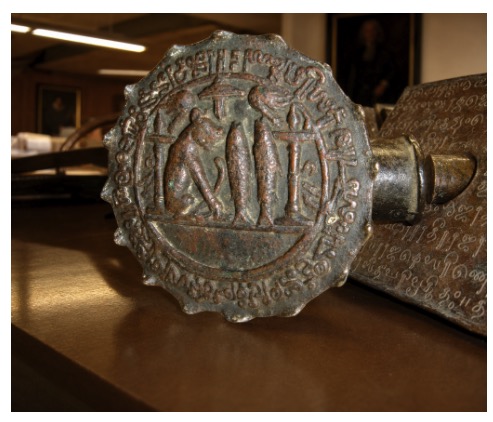
For over a century, a massive set of engraved copper sheets held together by a heavy royal seal rested inside the Asian Library at Leiden University in the Netherlands. Known internationally as the Leiden Plates, these 11th-century charters—officially termed the Anaimangalam Copper Plates—are among the most significant epigraphic treasures of South Asian history.
Beyond their historic account of royal patronage, these plates have recently re-entered the global spotlight as a landmark case study in international restitution, cultural diplomacy, and the decolonisation of European institutional archives.
What Are the Anaimangalam Copper Plates?
Issued during the reigns of Rajaraja Chola I and his son Rajendra Chola I, the charter records a royal grant (sasana) of land revenue from the village of Anaimangalam near Nagapattinam in present-day Tamil Nadu.
The grant was endowed to support the Chudamani Vihara, a Buddhist monastery constructed at Nagapattinam by King Sri Mara-Vijayottungavarman of the Srivijaya Empire (present-day Indonesia and Malaysia).
Key Historical Significance:
- Inter-State Diplomacy: The charter provides rare contemporary proof of the deep geopolitical, commercial, and maritime relationships connecting South India and Southeast Asia long before European contact.
- Religious Pluralism: It showcases how devout Hindu monarchs like Rajaraja Chola actively patronised and funded major Buddhist institutions within their maritime trade hubs.
- Bilingual Epigraphy: The plates feature inscriptions in two languages—Sanskrit (written in the Grantha script, detailing royal genealogy) and Tamil (written in Tamil script, recording precise village boundaries and land administration details).
From Coromandel Coast to Leiden University - During the 18th century, amidst Dutch East India Company (VOC) operations along the Coromandel Coast, the plates were acquired and transported to Europe, eventually becoming part of the prestigious Asian Library collections at Leiden University.
- In Western academic circles, the artefacts were catalogued primarily through a secular, art-historical lens as rare epigraphic objects and paleographic specimens. In South Asia, however, such charters represent legally binding edicts, sacred memory artefacts, and living heritage connecting modern communities to their ancestral past.
- In Western academic circles, the artefacts were catalogued primarily through a secular, art-historical lens as rare epigraphic objects and paleographic specimens. In South Asia, however, such charters represent legally binding edicts, sacred memory artefacts, and living heritage connecting modern communities to their ancestral past.
The Decolonial Turning Point
In recent years, modern European institutions have re-examined the ethical underpinnings of colonial-era collections. Following formal requests and collaborative provenance investigations led by independent advisory panels in the Netherlands, the acquisition context of the plates was evaluated under contemporary ethical frameworks.
Recognising the involuntary loss of possession and the immense sacred and historical value the charter holds for its country of origin, steps were set in motion to return the Anaimangalam Copper Plates to India.
The repatriation of the charter represents more than just a physical transfer of metal; it marks a structural shift toward decolonial restitution—bridging the gap between European institutional archives and living global heritage traditions.